

NEWS
NEWS
How can we avoid the inside condensation on optics and improve brightness of led work lamps
04-07-2026
High performance led work lamps always involve two critical challenges in terms of internal condensation and maximizing brightness.They are actually closely related, as poor thermal management results in both light output and seal integrity.
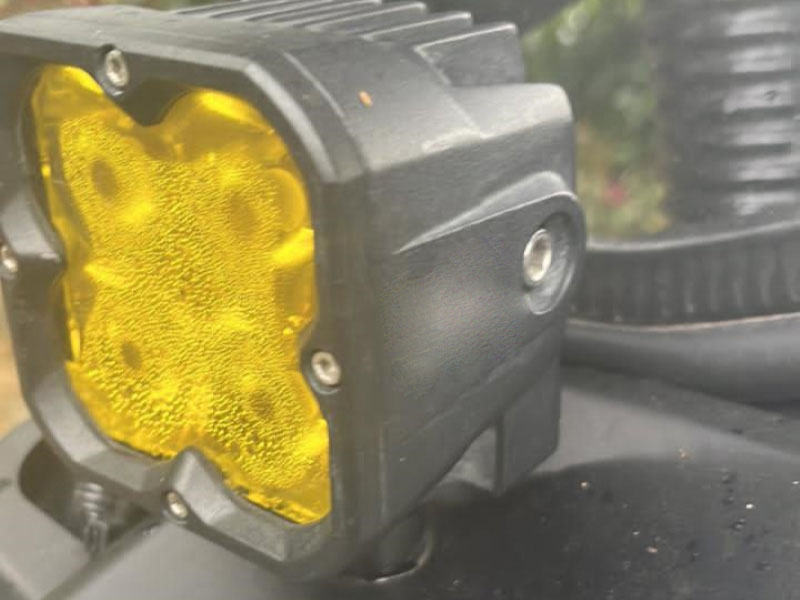
Condensation happens when the air inside the led work lamp warms up during operation and then cools rapidly after the led light is turned off. This creates a vacuum that pulls in moisture-laden air through tiny imperfections on the aluminum housings . When the lens cools below the dew point, that moisture condenses.
Instead of trying to create a completely hermetic permanent vacuum, install a microscopic breathable membrane. This allows air pressure to equalize naturally when the lamp heats up and cools down, while completely blocking moisture and dust.
Avoid cheap PVC or low-grade rubber gaskets, which degrade under UV and extreme temperatures. Use high-tier silicone or EPDM gaskets with a precisely calculated compression ratio such as around 25%. Ensure the diecast aluminum housing has a dedicated, smooth gasket groove to prevent shifting during assembly.
Also, applying a thin layer of high-quality, non-outgassing silicone vacuum grease to the gaskets and wire entry points, it is also necessary to add an extra layer of moisture-proofing and prevents capillary action along the power cord.
However, even a perfectly sealed lamp will condense if it was assembled in a high-humidity environment. Seal the led work lamps in a temperature- and humidity-controlled clean room , or use a dry nitrogen purging system right before final sealing process.
In contrast, maximizing brightness isnt just about driving more current into the LEDs and dry the optics; it’s about maintaining efficiency. As LED junction temperature (Tj) rises, its luminous efficacy drops, and the phosphor can degrade, causing the light output to dim and shift toward an undesirable cool, bluish tone.
The aluminum housing must have optimized vertical cooling fins to maximize surface area for natural convection. Minimize the thermal path from the LED die to the outside air.
The thermal paste between the PCB and the aluminum housing must have high thermal conductivity. Apply it evenly and thinly; too much paste acts as an insulator rather than a conductor.
Ensure the outer PC optics or optical len has high light transmittance and is treated with a UV-stabilized coating to prevent yellowing over time, which will severely makes the led work lamp much dim.
Condensation happens when the air inside the led work lamp warms up during operation and then cools rapidly after the led light is turned off. This creates a vacuum that pulls in moisture-laden air through tiny imperfections on the aluminum housings . When the lens cools below the dew point, that moisture condenses.
Instead of trying to create a completely hermetic permanent vacuum, install a microscopic breathable membrane. This allows air pressure to equalize naturally when the lamp heats up and cools down, while completely blocking moisture and dust.
Avoid cheap PVC or low-grade rubber gaskets, which degrade under UV and extreme temperatures. Use high-tier silicone or EPDM gaskets with a precisely calculated compression ratio such as around 25%. Ensure the diecast aluminum housing has a dedicated, smooth gasket groove to prevent shifting during assembly.
Also, applying a thin layer of high-quality, non-outgassing silicone vacuum grease to the gaskets and wire entry points, it is also necessary to add an extra layer of moisture-proofing and prevents capillary action along the power cord.
However, even a perfectly sealed lamp will condense if it was assembled in a high-humidity environment. Seal the led work lamps in a temperature- and humidity-controlled clean room , or use a dry nitrogen purging system right before final sealing process.
In contrast, maximizing brightness isnt just about driving more current into the LEDs and dry the optics; it’s about maintaining efficiency. As LED junction temperature (Tj) rises, its luminous efficacy drops, and the phosphor can degrade, causing the light output to dim and shift toward an undesirable cool, bluish tone.
The aluminum housing must have optimized vertical cooling fins to maximize surface area for natural convection. Minimize the thermal path from the LED die to the outside air.
The thermal paste between the PCB and the aluminum housing must have high thermal conductivity. Apply it evenly and thinly; too much paste acts as an insulator rather than a conductor.
Ensure the outer PC optics or optical len has high light transmittance and is treated with a UV-stabilized coating to prevent yellowing over time, which will severely makes the led work lamp much dim.
©Copyright: 2008-2026 Guangzhou TEEHON Electronics Co., LTD. 