

What can we do to improve the heat dissipation on high power led work lights at stationary installation
31-10-2026
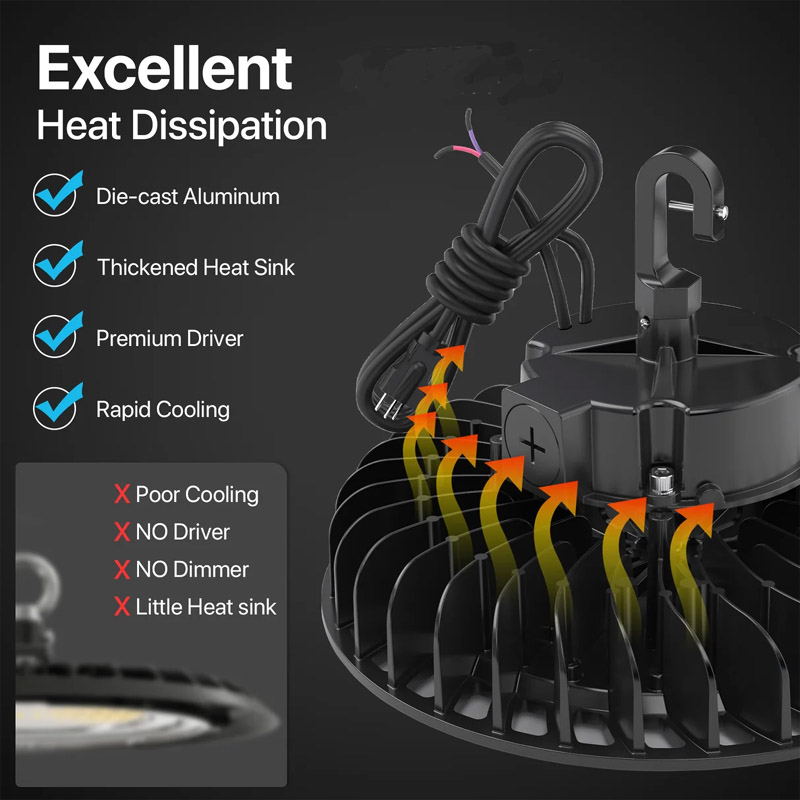
When high-power LED work lights are set for stationary installation ,for example, a heavy duty truck parked at a work site, a stationary agricultural tractor, or a construction site lighting , they face a complete loss of forced convection.
When a vehicle moves at high speed, ambient airflow sweeps across the diecast aluminum housing, taking away the heat rapidly. In a stationary installation, heat dissipation depends entirely on natural convection and radiation. The stagnant boundary layer traps heat around the lighting fixture, causing junction temperatures to the highest level and threatening phosphor degradation, solder fatigue, and lumen depreciation.
Instead of relying on a rigid, worst-case power limit or risking thermal runaway, dynamic components utilizes real-time telemetry from NTC thermistors mounted directly on the aluminum substrate PCBA.
When the led work lamp is stationary and internal temperatures climb past a predetermined threshold, the microcontroller uses PWM (Pulse Width Modulation) or constant-current driver adjustment to gently scale down drive current at allowed voltage.
Rather than abruptly cutting power or flickering, advanced drivers ic dynamically balance lumen output against thermal equilibrium—maximizing usable light output without crossing thermal safety limits.
Stationary installations are the best choice for hybrid cooling architectures that switch behavior based on vehicle telemetry or operational state:
Some High-output laser lamps/LED pod lights can integrate low-profile, dustfree double bearing micro-fans at the back. When the system detects a stationary state, it engages the active fan to force airflow across the fins. When the vehicle is moving, natural airflow takes over, and the fan spins down or turns off to save power and eliminate mechanical wear.
Embedded ics manages fan RPM dynamically based on real-time temperature gradients rather than running them at full speed constantly, extending fan lifespan.
Moving led work lights optimize for drag coefficient and high-speed laminar airflow; stationary lights optimize for chimney effects and buoyant thermal plumes.
Enclosures are engineered with open, vertical cooling channels that maximize the stack effect—pulling cool air in from the bottom and exhausting heated air out the top purely through natural thermal buoyancy.
Fin thickness and inter-fin spacing on smaller led work lamps are widened slightly compared to high-speed long light bars to prevent boundary layer interference, ensuring unimpeded natural air circulation in static environments.
Stationary LED work lights often experience quick thermal surges when turned on in hot, windless environments before natural convection fully establishes its steady-state equilibrium.
Integrating paraffin-based or microencapsulated Phase-Change Materials inside the aluminum housing cavity or directly beneath the aluminum substrate PCB allows the system to absorb a great amount of latent heat in short time, buffering the junction temperature until steady-state natural convection works for stable heat dissipation.
©Copyright: 2008-2026 Guangzhou TEEHON Electronics Co., LTD. 